









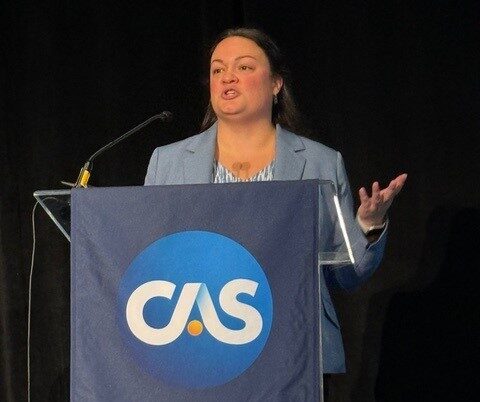
For those of us lucky enough to see and hear Kay Wakeman of the Insurance Institute for Highway Safety and the Highway Loss Data Institute (HLDI) at the 2025 CAS Annual Meeting, we were treated to a masterclass in understanding the fleet on the street of U.S. vehicles in operation.
Wakeman portrayed the dynamics of consumer demand for safety, comfort, and technology as a key input to automakers’ development and production roadmaps – especially across the last decade.
In particular, in the last ten years we have seen the dominance of the SUV, the scaling emergence of advanced driver assistance systems (ADAS) features, and a wider acceptance of electrified vehicles (hybrids, variants, and full EV powertrains), which are heavier, more powerful, more tech-laden, and faster acceleration with high torque drivetrains than any set of production vehicles we’ve seen before.
Wakeman talked about the many new technologies entering the fleet. Some are working better than hoped, while others are failing to meet their hypothetical promises. She also described how wild and difficult it is to anticipate loss cost dynamics around parts supply, maintenance, service, repair, replacement, and calibration (not to mention tariff impacts) of the mix of features across the roughly 1.25 million cars produced each month over the last decade.
The insurance industry sponsored and collaborative research with IIHS/HLDI has led to significant and tangible road safety improvements for Americans with timely feedback to auto manufacturers. This industry-supported work is actively saving lives.
A new data point being enabled by HLDI researchers focuses on the issue of blind spots involving pedestrians and forward left turns – the pillars around windshields block the sight of drivers with the largest obstruction due to the closer pillar on the left. HLDI engineers have curated specific observability data and correlated these to pedestrian involved accidents – the obvious “you can’t avoid what you can’t see.” This effect can be even worse on higher vehicles with wider pillars.
Attendees learned about how these changes are associated with shifts in safety outcomes and claim frequency, claim severity, or both. While 15 million vehicles a year (the estimate of new cars produced annually in the U.S.) sounds like a lot, since they are joining almost 300 million vehicles on the street, Wakeman explained that the timelines from introduction to full fleet penetration can lag when only the newest 5% of vehicles each year have the most important new features.
Wakeman also described the difficulties remaining in mapping specific vehicle “as built” optional features into IIHS/HLDI research capabilities – the “unknown” line (the optional versus standard or not available legends) on IIHS/HLDI charts and reports remains an operational blind spot for the insurance industry. This lack of information occurs when VIN decoders do not have explicit definitions of technologies installed on each vehicle, only general vehicle descriptions.
She addressed that about a dozen ADAS features are currently in market and optionally available on the newest vehicles, and she projected their future uptake across automakers. Some of these changes occur organically, and others are a result of legislation, like rearview cameras. At the same time, it was noted that the pipeline of innovations for making vehicles safer is thinning.
The reduction in frequency of claims due to these features is often dramatic, while changes in severity need careful analysis to address “mean shifting” observed where the reduction in low severity claims tend to make the remaining claims appear more expensive on average. This can be confounding in some situations, since things like automatic emergency brakes for a forward collision may be necessarily engineered for different speeds of travel instead of every speed of travel. Where a technology that operates at lower-speed ranges may eliminate most of those with a complete avoidance, a technology that operates at higher vehicle speeds would still show up in the lower-speed ranges. That would make the data look different than normal since the overall frequency of accidents in this scenario would be unaffected, but more lower-speed claims would appear as the mid-speed ranges were hollowed out. No system of AEB for high or very high-speed situations have emerged. Thus, in a mix of OEMs and a mix of technology, understanding the claims implications of varying technology operating characteristics is now also important.
Wakeman concluded with an optimistic outlook for improving safety conditions as effective ADAS are deployed in increasingly larger percentages of vehicles on the street. She challenges the industry to remain vigorous in studying the real world details of how drivers manage these technologies – when they are disabled at the discretion of the driver, they are false prophets of improved safety while being just as expensive to repair in a loss.
Martin Ellingsworth is president at Salt Creek Analytics.